THE DIE IS BROADCAST

Showing posts with label C and C Ancients. Show all posts

Monday, 25 May 2015

COMMANDS & COLORS ANCIENTS CAMPAIGN - TICINCUS RIVER .

 Ticincus River 218 BC.

Fellow grognard Arthur and myself have decided to run a Commands and Colors Ancients Campaign. It has been over five years since we last played campaigns in this system. The plan is to re fight all the second punic war battles which took place in Italy between the Carthaginians and Romans. Arthur has been painting like a demon to prepare some 1/72 plastic figures for the campaign. First battle in the campaign is Ticincus River 218 BC. We used the excellent ccancients.net website for resources to plan the campaign games. We will play each game back to back and swap sides.


Hexon terrain titles and 1/72 plastic figures.


Kids Connect 4 game proves useful as a scoreboard. 

Historical Background - Ticincus River
Hannibal has completed his epic march across the Alps, but has lost fully half of his soldiers in doing so. The Consul in Southern Gaul, Publius Scipio, has shadowed Hannibal’s advance following the coastal route. He intercepts Hannibal in Northern Italy as he is rebuilding his army with Gallic recruits. Neither commander is willing to bring on general battle, but Scipio does advance his light troops and cavalry, unaware of how much better the Carthaginian cavalry was than his own. Hannibal counters with his cavalry, including the fearsome Numidian light horse. Hannibal gives Scipio a tactics lesson. His heavy cavalry smashes into the light infantry, drawing the Roman cavalry into the fight. At that point, the Numidians hit both flanks, driving off the disorganised surviving cavalry, wounding Publius Scipio in the process. Historical result, victory to the Carthaginians.

6 Banners needed for a victory. 5 command cards to Carthaginians 4 to the Romans.

114 Plays recorded on ccancients.net as of 24-05-15.

56.3 % - Carthaginian
43.7 % - Romans

In our battles the Carthaginians won both games 6 banners to 2. The tactic of using light cavalry to surround and trap units proved very successful for both players as the Carthaginians. A lucky roll by myself as the Romans managed to bag a Carthaginian leader for a two banner result in the first game. As the Carthaginians I learnt from the sharp lessons handed out by Arthur and pushed up my light and heavy cavalry to trap Arthur's Romans on the base line causing many units to flee and retreat for easy banners.

Starting positions.

One stand represents a unit, coloured tokens represent hits.

So after game one in the campaign all is square. Eight banners each.

Thursday, 20 February 2014

Sunday, 17 February 2013

IN THE BEGINING.


The "War Room's" inaugural opening day kicked off on Saturday with a range of table top games being played.  Arthur and Dave played a Commands and Colors Napoleonic break through battle -Vimiero. As always the game looks great when played on the double sized hex terrain.


My self and Al played the Ancient version of Commands and Colors and the battle of Panion. Sadly I got a spanking and the now familiar bitter taste in the mouth feeling. The scenario was great fun and had plenty of decisions and choices, making it an  interesting and exciting experience. I have included a few snaps of the game, see below. The pictures are not great as my kids have been toying with the settings on the camera. Hope they don't hurt the eyes to much.


Ross, Steve, Daniel, Glynn and the rest of the guys played Necromunda, X-Wing, Wings of War and Warhammer 40K. All in all the day was a good start to "The War Room" club.


Sunday, 28 October 2012

10mm HEAVY CAVARLY


10mm Successor Companion Cavalry. The "Companions" were the elite cavalry of the Macedonian army from the time of king Philip II of Macedon and reached the height of their prestige under Alexander the Great.
 
In battle, it would form part of a hammer and anvil tactic: the Companion cavalry would be used as a hammer, in conjunction with the Macedonian phalanx-based infantry, which acted as their anvil. The phalanx would pin the enemy in place, while the Companion cavalry would attack the enemy on the flank or from behind. In battle Alexander the Great would often personally lead the charge at the head of the royal squadron of the Companion cavalry, usually in a wedge formation.

I use these figures as heavy cavalry for Command and Colors Ancients. They are best employed to punch holes and divide up the enemy lines. Be careful however, as you must provide room for them to retreat or they can be destroyed if caught.

These figures are by Magister Militum and are from their Ancient Successor range.

Thursday, 18 October 2012

10mm CATAPHRACT.


The heavy weights, some Caraphract cavalry. Historically, the cataphract was a very heavily armoured horseman, with both the rider and steed draped from head to toe in scale armour, while typically wielding a kontos or lance as their weapon. Cataphracts served as either the elite cavalry or assault force for most empires and nations that fielded them, primarily used for impetuous charges to break through infantry formations.
 
I employ them as usual for the Commands and Colors Ancients system. Slow moving but carrying a mighty punch. They can ignore a sword hit and are best employed to create holes and divide up the enemy lines.  They are based three figures to a stand and three stands make up a unit. These figures were painted by gamer buddy Glen, to his usual high standard.

Tuesday, 9 October 2012

10mm MEDIUM CAVALRY


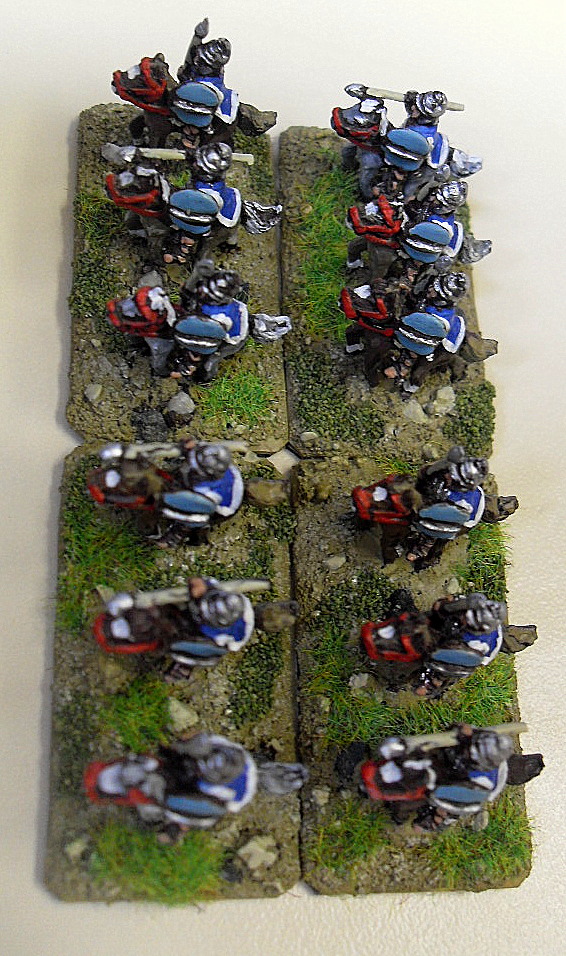
Above are a few photographs of my Successor cavalry using Magister Militum figures. I based them 3 figures to a stand, four stands to a unit. They are used as medium cavalry in the Commands and Colors Ancients system.

Medium cavalry are one of the better cavalry units in Commands and Colors. They have a movement of 3 and can battle again after a momentum advance. With an attached leader they can quickly tear holes in the enemy lines. But beware however, with a retreat of 3 hexes they can quickly lose strength if caught near the base line.

Wednesday, 12 September 2012

LIGHT SLINGERS


Light Slingers troops for use in Commands and Colors Ancients. Two figures to a stand and four stands to a unit. These are weak units. Their one advantage is that they have a long range, three hexes. Some think that this ability is too strong and unbalances Commands and Colors scenarios. It is best to keep your distance with this troop type and shower the enemy with missile fire. Its also important to make use of cover in forests, broken ground and hills. Always evade with slingers if engaged in Close Combat. Like all light troops they are useful for masking medium and heavy infantry from missile fire and flank counter attacks in close combat. 

Thursday, 30 August 2012

LIGHT INFANTRY


Another of my instalments on Commands and Colors Ancients and its conversion to the tabletop using 10mm figures. These figures are by Magister Militum and are being used as light troops. With two figures to a stand and four stands to a unit.

The light infantry are the weakest in the Commands and Colors Ancient system but used well can be quite effective. They are best employed to screen better forces or to harass the enemy with ranged combat.  They must evade direct close combat in most circumstance. Like all skirmish troops they are most effectively employed in terrain- forest, hills and broken ground.

Their shooting can have an attritional effect if the Dice Gods are with you. So always sacrifice a goat before the game, the Dice Gods love goat. I have found them useful to harass formed units, fading away when confronted to reappear with more ranged combat. Its great to use light troops to pick off a weaked heavy or medium unit towards the game end and gain that all important winning victory banner.

I also like to employ light units to hold up and harass enemy units attempting encircling manoeuvre's or use them to defend a river crossing. They get to roll the same two dice as other units at a river so their relative weakness in normal play is less off an issue.

So light infantry, light weight they are not if used well.